A2A Integration Test Kit Dashboard
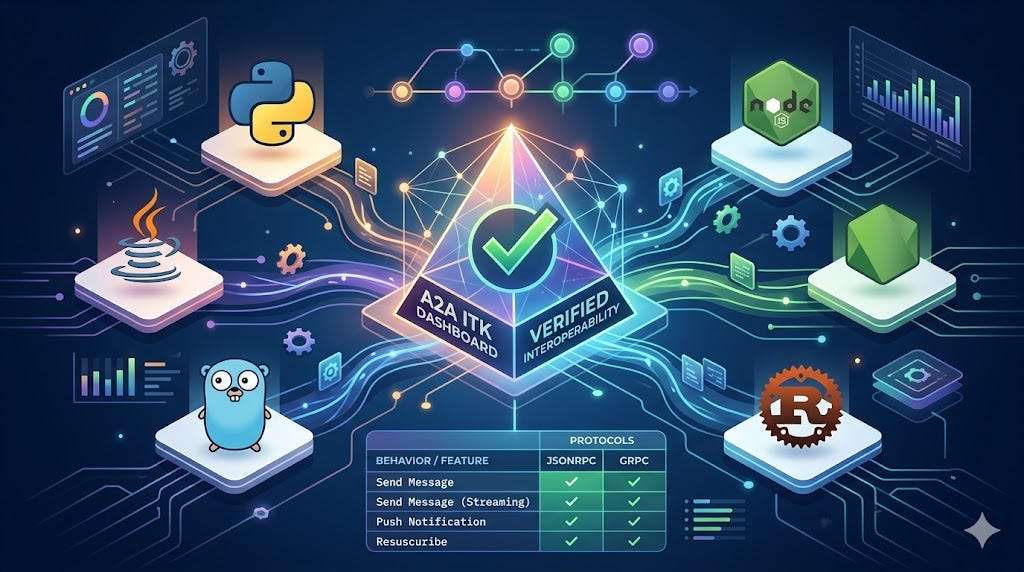
Interoperability shouldn’t be an afterthought. In a world of diverse AI frameworks, the A2A protocol is building the common language for agents to collaborate seamlessly. Today, we’re making that mission measurable.
Introduction
The A2A protocol is more than just a specification; it’s an open communication language designed for independent agents to talk and work together. Originally developed by Google and now part of the Linux Foundation, A2A is the definitive common language for agent interoperability in an ecosystem where agents are built by different vendors across diverse frameworks.
Why Interoperability Matters
Building a standalone agent is one thing, but getting a Python agent to collaborate with a Go or Rust agent without custom glue code is the real challenge. While the A2A protocol establishes the common language for agents to collaborate, the Integration Test Kit (ITK) and its Dashboard provide the vital verification and visibility needed to maintain consistency. The ITK acts as a toolkit to verify compatibility across different SDK implementations by routing test messages, while the Dashboard centralizes this data(test results) into a holistic interoperability matrix. This ensures that agents built across diverse frameworks can integrate robustly throughout the protocol’s evolution.
Note: We recently presented this dashboard to the A2A Technical Steering Committee (TSC) to gather feedback. Please share your feedback.
How the Dashboard Works
The A2A ITK dashboard performs automated interoperability checks between various A2A SDKs. For example, for Python SDK ITK tests, it utilizes the latest SDK code from its GitHub repository and runs cross-compatibility checks against the following versions:
- Stable Versions: Python v1.0 and Go v1.0
- Legacy Versions: Python v0.3 and Go v0.3
Support for additional SDK languages and versions will be expanded in future iterations.
Understanding the Dashboard Layout
To provide comprehensive and detailed metrics, the ITK Dashboard is organized into two distinct sections.
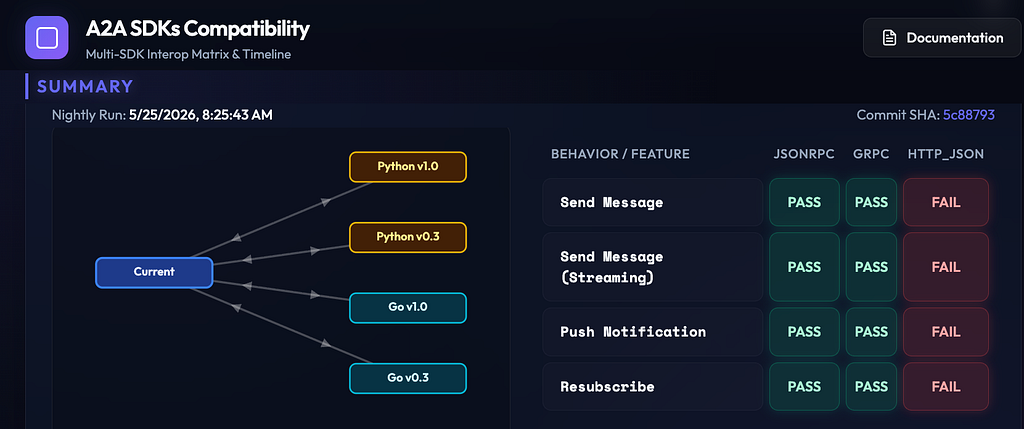
A. Summary Table (Holistic Picture)
The summary table below provides a holistic view of how the current SDK interoperates with others. This view includes checks for stable versions like Python v1.0 and v0.3, as well as other SDKs such as Go, evaluated across various behaviors and protocols (e.g., JSON-RPC, gRPC, and HTTP/JSON).
B. Pairwise Interoperability Matrices
The pairwise interoperability matrices in the section below drill down into pairwise compatibility. These matrices verify full compatibility between specific versions, ensuring robust integration throughout the protocol’s evolution.
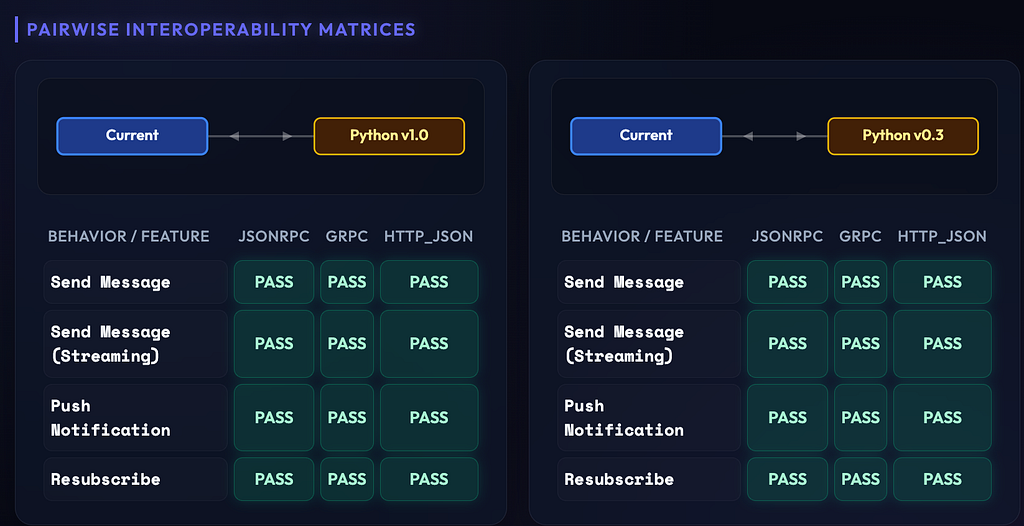
Use this section to debug niche edge cases or to verify if a protocol upgrade will safely support legacy clients in production.
Status Legend
- PASS: The feature is fully functional and compliant between the tested versions.
- FAIL: A regression or incompatibility was detected. Investigation is required.
- Not Covered: Test cases for this specific feature combination have not yet been implemented.
🚀 Get Involved & Next Steps
As an evolving tool designed to maintain the stability of the A2A ecosystem, we encourage your participation. Here is how you can take action right now:
- Spot a Failure? If you notice a FAIL status on a feature you rely on, please check the active issues or sync with the team in the#a2a-tck Discord channel.
- Contribute Test Cases: Help us expand our coverage! If you are developing new features for any A2A SDKs, ensure you add corresponding integration tests to theITK GitHub Repository.
- Track Upcoming Support: We are actively working on expanding our test matrices to include TypeScript/Node.js , Java, Rust , and .NET environments soon. Keep an eye on our ITK Roadmap for delivery timelines.