Beyond the Prompt: Why Your Next AI Agent Needs a Brain (The COALA Architecture)
💡 Originally published on Google Cloud Community on Medium.
TL;DR
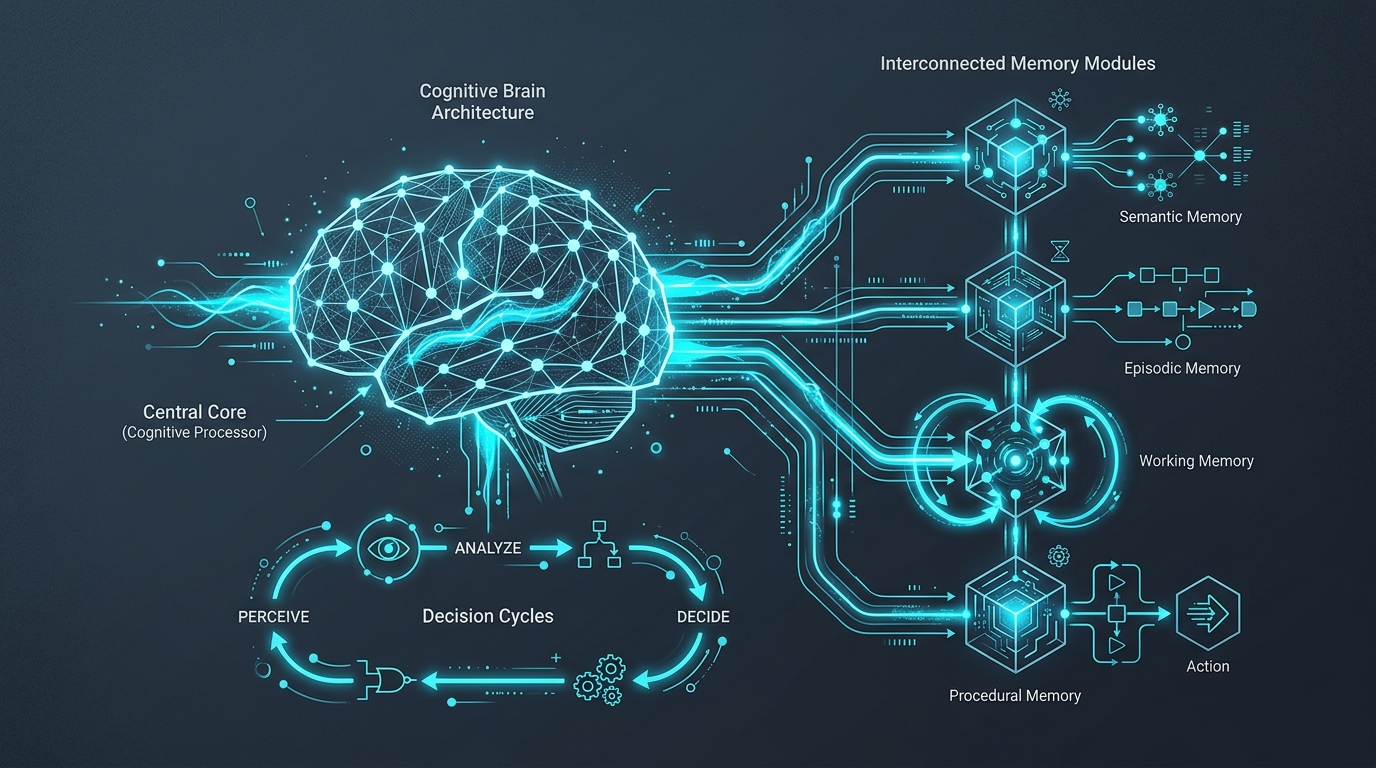
Single prompts and simple reactive loops cannot support robust, long-horizon autonomous agents. The COALA (Cognitive Architectures for Language Agents) framework structures AI agents around human cognitive principles: modular memory systems (working, episodic, semantic, procedural), explicit action spaces, and structured decision cycles (Perception $ ightarrow$ Reasoning $ ightarrow$ Action $ ightarrow$ Learning). Implementing COALA transforms brittle prompt chains into resilient, stateful agents capable of long-term problem solving.
The Limitations of Prompt-Only Agents
Most AI agent prototypes rely on a single loop: prompt LLM $ ightarrow$ parse output $ ightarrow$ call tool $ ightarrow$ append to prompt history. As tasks grow in complexity, this naive approach hits severe walls:
- Context Bloat & Rot: Relevant facts are pushed out by conversational filler.
- Action Confusion: Agents fail to differentiate between internal reasoning and external world-altering actions.
- Absence of Learning: Once a session terminates, experiential knowledge gained during task execution vanishes.
The COALA framework addresses these challenges by decomposing agent intelligence into structured cognitive modules.
The COALA Cognitive Blueprint
graph TD
    subgraph CognitiveCore["COALA Agent Core"]
        PERCEIVE["1. Perception & Environment Ingestion"] --> REASON{"2. Reasoning & Planning Engine"}
        REASON --> ACTION["3. Action Execution (Internal / External)"]
        ACTION --> LEARN["4. Experiential Learning & Memory Update"]
    end

    subgraph MemoryModules["Modular Memory Hierarchy"]
        WM["Working Memory<br/>(Active Context / Task Variables)"]
        EM["Episodic Memory<br/>(Past Trajectories & Experiences)"]
        SM["Semantic Memory<br/>(Factual Knowledge & World Models)"]
        PM["Procedural Memory<br/>(Skills, Tool Definitions, Code Rules)"]
    end

    REASON <--> WM
    REASON <--> EM
    REASON <--> SM
    REASON <--> PM
    LEARN --> EM
    LEARN --> PM
1. Modular Memory Systems
COALA divides agent memory into four functional subsystems:
| Memory Type | Purpose | Implementation Pattern |
|---|---|---|
| Working Memory | Maintains active task state, focus variables, and current goal decomposition | Short-term context window buffer & structured scratchpad |
| Episodic Memory | Stores chronological logs of past task executions, mistakes, and user interactions | Vector database (Vertex AI Vector Search) + timestamped logs |
| Semantic Memory | General knowledge, business domain rules, and world models | RAG systems, Knowledge Graphs, and document stores |
| Procedural Memory | Execution skills, codified recipes, and tool usage guidelines | System prompts, few-shot tool examples, and Python scripts |
2. The Decision-Making Cycle
Rather than generating unstructured output, COALA agents cycle through structured execution stages:
sequenceDiagram
    autonumber
    actor Env as Environment / User
    participant Agent as COALA Agent Core
    participant Memory as Memory Subsystem
    participant Tools as External APIs / Tools

    Env->>Agent: Send Task Request
    Agent->>Memory: Query Semantic & Episodic context
    Memory-->>Agent: Relevant past experiences & domain rules
    Agent->>Agent: Formulate multi-step action plan
    loop Execution Step
        Agent->>Tools: Dispatch tool action
        Tools-->>Agent: Observation result
        Agent->>Memory: Update Working Memory state
    end
    Agent->>Memory: Commit episodic trajectory (Lessons Learned)
    Agent-->>Env: Return Verified Task Output
Practical Takeaways for Builders
- Separate Internal vs External Actions: Allow the agent to update internal memory and plan without triggering premature external tool calls.
- Implement Structured Handoffs: Pass lightweight working-memory state summaries between sub-agents rather than dumping the entire conversational history.
- Codify Procedural Memory: Store frequently used multi-step sequences in declarative configuration files (or
AGENTS.md) rather than expecting the LLM to reinvent them each session.