
Google Cloud Next 2026 (2/5) - GAP & Foundational Models
This is from my personal collection/notes. Hope you find it informative :)
In our first post, we explored key hardware developments such as 8th-Gen TPUs, Axion processors, and Virgo Networks. Today, let's review the framework tying them together: Google Cloud's Gemini Enterprise Agent Platform. For simplicity, I like to refer to it as Google's Agent Platform (GAP) or simple Agent Platform (AP).
One could easily assume GAP is simply a rebranding of Vertex AI, but it goes much further. It represents the natural evolution of Vertex AI, reflecting Google's intent to simplify the developer journey for building cloud-native agentic systems. GAP unites model selection, building, and agent development alongside advanced DevOps, orchestration, integration, and security.
Quick Tip: I've shared a list of these products with brief descriptions below. Skim through and bookmark this page as a handy reference!
Google Agent Platform (GAP)

Note: For my easy of use, I casually refer to it as Google Agent Platform (GAP) or simply Agent Platform (AP).
🛠️ Build
- Agent Development Kit (ADK): A code-first, graph-based framework for defining complex multi-agent logic and reasoning.
- Agent Studio: A low-code, visual interface enabling developers to seamlessly move from simple prompting to deploying sophisticated agents.
- Agent Garden: A curated library of pre-built templates designed for specific operational tasks like financial analysis and invoice processing.
- Native Ecosystem Integrations: A plug-and-play architecture to securely connect agents to internal enterprise data and tools without custom code.
- Workspaces: A hardened, sandboxed environment for agents to safely execute bash commands and manage files.
🌎 Scale
- Agent Runtime: A high-performance execution engine providing sub-second cold starts and native support for multi-day workflows.
- Agent Memory Bank: Dynamically generates and curates long-term "memories" to maintain context across numerous user interactions.
- Agent Sessions: A management tool mapping AI interaction history directly to internal CRM or database records using custom IDs.
- Agent Sandbox: A secure environment for agents to execute model-generated code and carry out browser-based automation.
- Bidirectional Streaming: A robust protocol utilizing WebSockets to enable lag-free, real-time audio and video interactions.
🕹️ Govern
- Agent Identity: Assigns a unique, cryptographic ID to every agent, ensuring actions remain auditable and secure.
- Agent Registry: A centralized enterprise library for indexing and discovering approved agents, tools, and skills.
- Agent Gateway: The main control hub governing connectivity and consistent security policy enforcement across agent swarms.
- Agent Policy: Deterministic rules enforced via a Policy Engine to govern access controls and business constraints by intercepting agent messages.
- Agent Anomaly Detection: Real-time monitoring leveraging statistical models to flag unusual reasoning or suspicious agent behavior.
- Agent Security Dashboard: A unified interface integrated with Security Command Center to visualize threats and monitor vulnerabilities.
- Model Armor: An advanced AI firewall screening all prompts and responses against specific threats, including prompt injection, jailbreaks, and sensitive data leakage.
🧮 Optimize
- Agent Simulation: A robust testing environment generating synthetic user interactions to score agent success and safety before production.
- Agent Evaluation: Continuously scores live traffic using multi-turn "autoraters" to judge entire conversation flows.
- Agent Observability: Delivers execution traces and visual lenses into agent reasoning to streamline developer debugging.
- Agent Optimizer: Automatically clusters real-world failures and suggests instruction refinements to boost precision.
✨ Google Foundational Models
While GAP provides the operational architecture, the underlying Gemini 3.x family drives the "intelligence" of the agentic era. Here is a great review to get started on the new models:
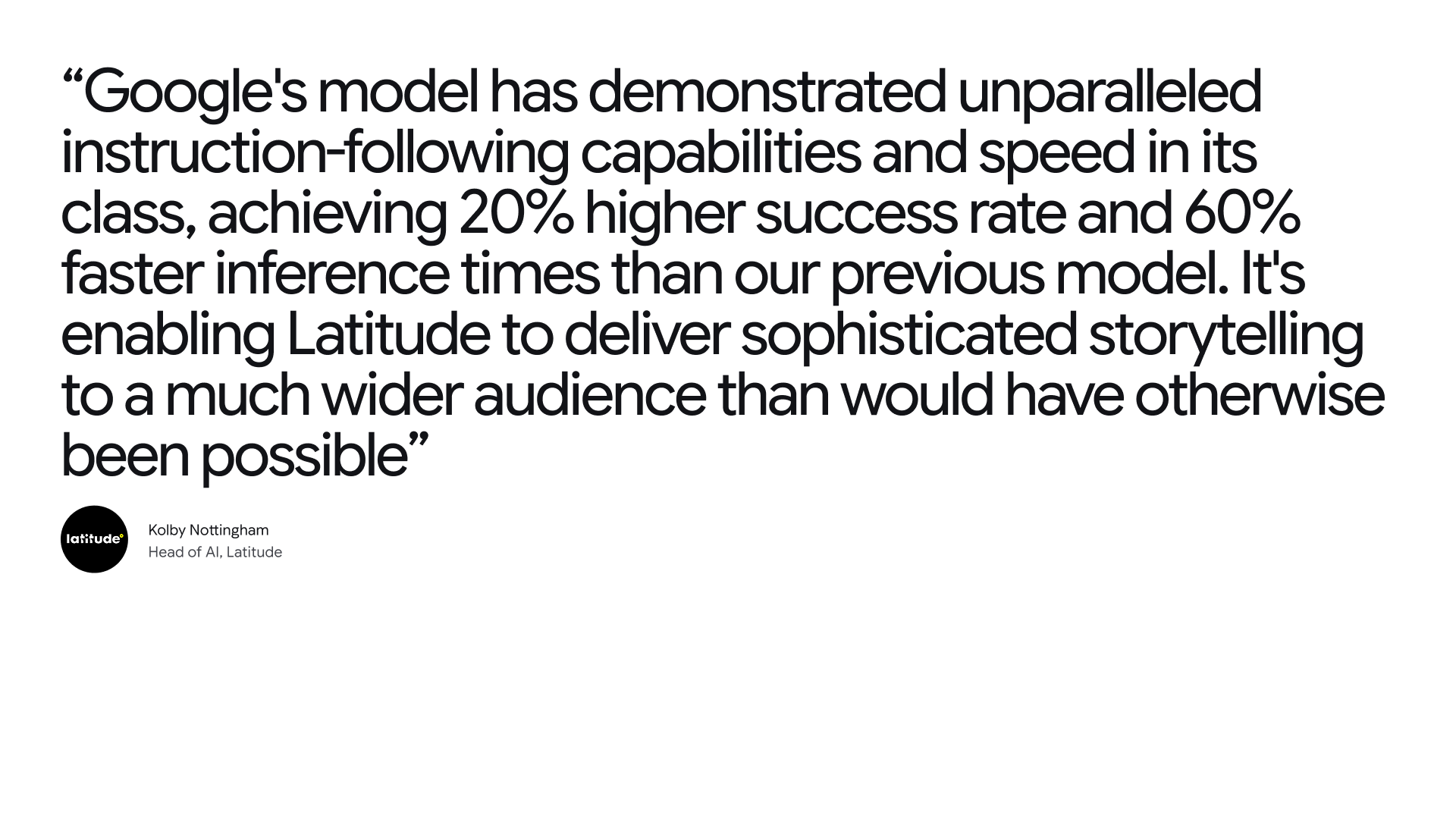
- Gemini 3.X Models: Google's most capable models for complex reasoning, large-scale data analysis, and sophisticated multi-agent orchestration.
- Nano Banana 2: A high-speed, multimodal model optimized for low-latency visual reasoning and image processing.
- Lyria 3: A specialized model engineered for high-fidelity audio generation and advanced musical AI applications.
- Gemma 4: The newest generation of lightweight, open models built with core Gemini technology for efficient edge deployments (available under the Apache 2.0 License!).
Notably, Google Cloud doesn't restrict developers to first-party options. Thanks to robust partnerships, the Model Garden grants access to over 200 first-party, open-source, and third-party models including Anthropic's Claude series, LLaMA, Mistral, Qwen, DeepSeek, Nemotron, and more.
To read more:
Curious about how developers actually interact with all this? In my next post, we will cover Google’s modern Developer Tools, guides, and new MCP Servers!